If you are a student or teacher preparing for the Class 10th annual examinations in Punjab, understanding the math pairing scheme 2026 is one of the most important steps toward scoring high marks. The pairing scheme, also known as the paper scheme or assessment scheme, tells you exactly which chapters are combined together for objective and subjective questions in the board exam. This guide covers the complete Class 10th math pairing scheme 2026 for all Punjab boards, including Lahore Board, Gujranwala Board, Rawalpindi Board, Multan Board, Sahiwal Board, Faisalabad Board, Sargodha Board, DG Khan Board, and Bahawalpur Board.
What Is a Pairing Scheme, and Why Does It Matter?
The pairing scheme is an official guideline issued by the Punjab Curriculum and Textbook Board (PCTB) and followed by all BISE Punjab boards. It shows which units are paired together for MCQs, short questions, and long questions. For Class 10th math, this scheme helps students focus their preparation on the right chapters rather than wasting time on low-weightage content. Teachers also use it to plan revision classes and guess papers more accurately.
Class 10th Math Paper Pattern 2026
Before looking at the pairing scheme, it is important to understand the overall paper pattern for 10th class math in Punjab:
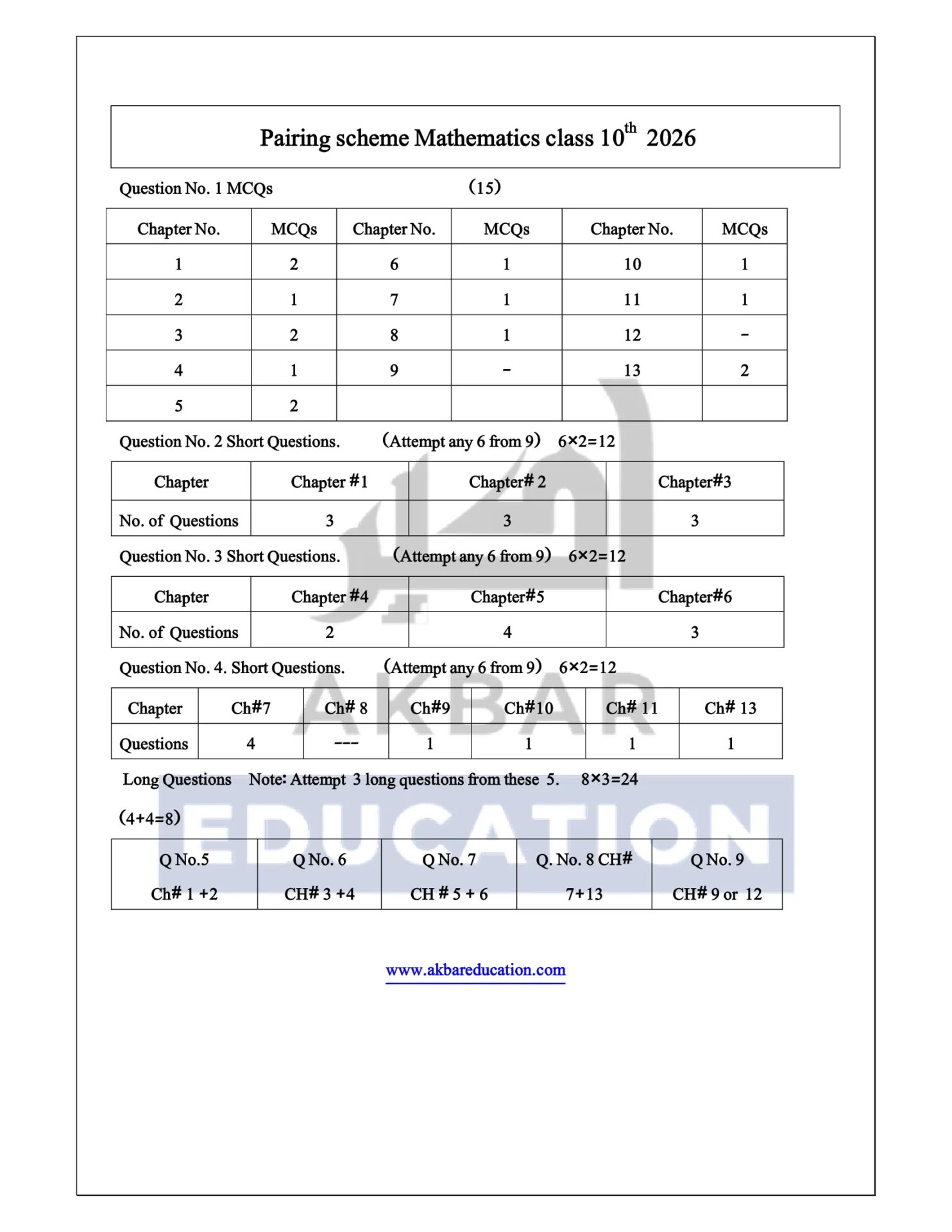
Download the class 10th Math Pairing Scheme 2026 in PDF.
Yoy can download the class 10th math pairing scheme 2026 in PDF from the link below.
Class 10th Math Pairing Scheme 2026 – Chapter-Wise Breakdown
Below is the expected pairing scheme for 10th-class mathematics based on the Punjab board pattern for 2026. This scheme aligns with the PCTB syllabus and previous board trends.
Objective Part – MCQs (Section A)
MCQs are taken from all chapters of the book. Each chapter contributes one or two MCQs. The main chapters in the 10th class math Punjab textbook include quadratic equations, the theory of quadratic equations, variations, partial fractions, sets and functions, basic statistics, an introduction to trigonometry, the projection of a side of a triangle, chords of a circle, tangent to a circle, chords and arcs, the angle in a segment of a circle, and practical geometry.
Section B – Short Questions
Part I of Section B covers algebra-related chapters. These typically include quadratic equations (Chapter 1), theory of quadratic equations (Chapter 2), variations (Chapter 3), partial fractions (Chapter 4), and sets and functions (Chapter 5). Students are asked to attempt 6 out of 9 questions from this part.
Part II of Section B covers geometry and statistics chapters. These include basic statistics (Chapter 6), introduction to trigonometry (Chapter 7), projection of a side of a triangle (Chapter 8), and the remaining geometry chapters. Again, students attempt 6 out of 9.
Section C – Long Questions
Three long questions are given, and students attempt any two. Typically, one question comes from algebra (quadratic equations or variations), one from trigonometry or statistics, and one from geometry (circles or practical geometry).
Important Tips for Using the Pairing Scheme
Students and teachers in Punjab should keep the following points in mind when using the 10th class math pairing scheme 2026.
First, the pairing scheme is a guide, not a guarantee. Board examiners can slightly adjust question selection each year, so it is important to cover the full syllabus rather than skipping any chapter completely.
Second, use the scheme to prioritize. Chapters that appear in both short and long questions deserve more attention. For 2026, quadratic equations and trigonometry are traditionally high-weightage areas.
Third, practice past papers alongside the pairing scheme. Five years of past papers from BISE Punjab boards, combined with this scheme, give students a strong advantage.
Fourth, teachers should use this scheme to design school tests and mock exams that match the real board paper format.
The Class 10th math pairing scheme 2026 is an essential tool for smart and focused exam preparation. Students across all Punjab boards, whether in Lahore, Multan, Rawalpindi, or Bahawalpur, follow the same PCTB-approved syllabus and paper pattern. By understanding how chapters are paired, which questions are compulsory, and how marks are distributed, both students and teachers can plan effectively and improve results.
Start your preparation early, use this pairing scheme wisely, practice regularly, and approach the 2026 board exam with full confidence.
Maqsood Akbar is a professional blogger and schoolteacher. He started as a teacher in 2011. He has been writing educational blogs for over a decade, with his articles being featured in top publications. His work has helped thousands of students and teachers navigate the fast-paced world of education. When he's not writing, he enjoys learning and researching the latest techniques.


One Response