
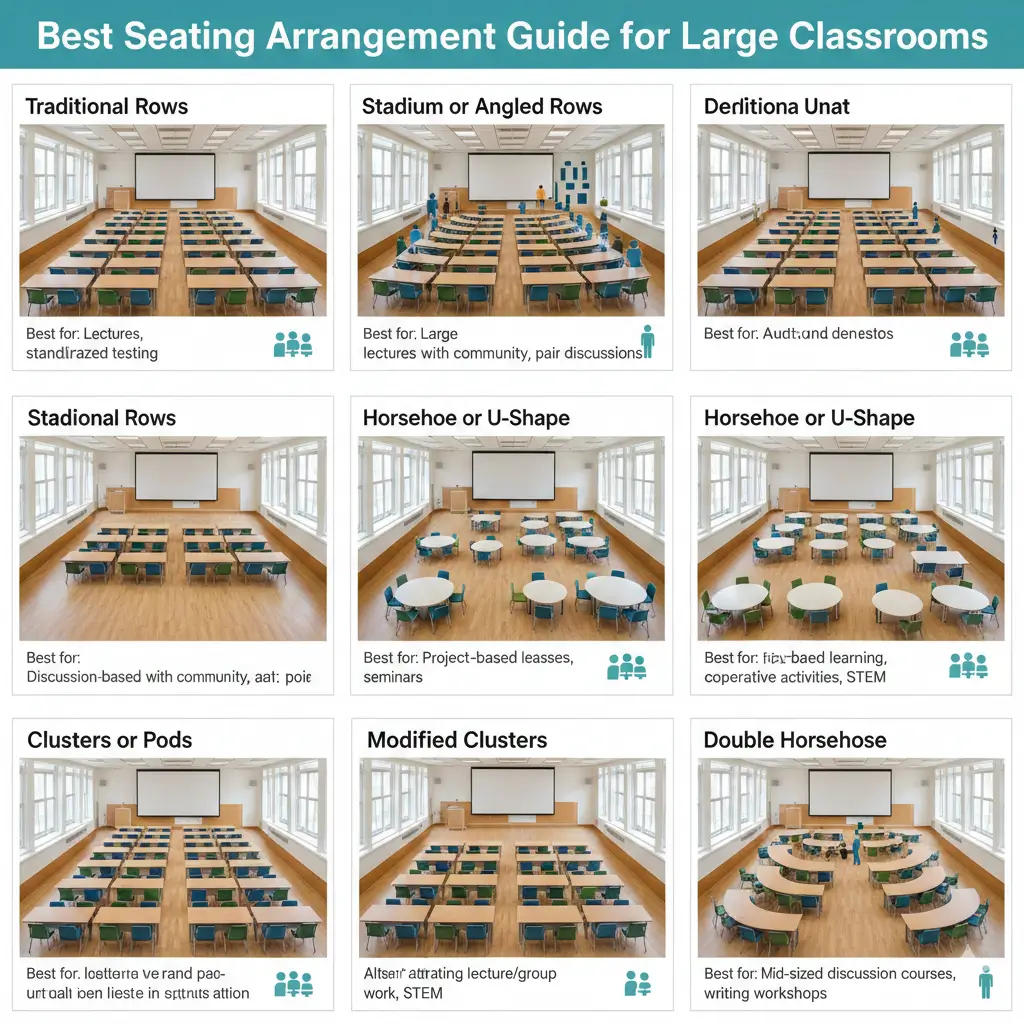
Choosing the right seating arrangement can significantly impact student engagement, classroom management, and learning outcomes. Here’s a comprehensive guide to help you optimize your large classroom space.
Understanding Your Needs First For Seating Arrangement
Before selecting an arrangement, consider your teaching style, subject matter, and students’ needs. A lecture-heavy biology course requires different seating than a discussion-based seminar, and a classroom of 30 students presents different challenges than one with 60.
Traditional Rows
The classic arrangement works well for large lectures where the primary focus is on the instructor or presentation screen. Students face forward in straight lines, maximizing the number of seats while maintaining clear sightlines to the front. This setup excels at minimizing distractions during tests and facilitates orderly movement in and out of the room. However, it can feel impersonal and makes group work awkward.
Lectures, auditorium-style classes, standardized testing, and upholding strict classroom control are all ideal.
Stadium or Angled Rows
A variation on traditional rows, this arrangement angles desk columns slightly toward the center, creating a gentle arc. Students gain better peripheral vision of their classmates while maintaining focus on the front. The subtle shift creates a more inclusive feeling without sacrificing the benefits of rows.
Best for: Large lectures where you want some sense of community, classes that mix lecture with occasional pair discussions.
Horseshoe or U-Shape
Desks form a large U around the room’s perimeter, leaving the center open. This arrangement puts every student on the “front row” and facilitates eye contact between all participants. The instructor can easily move into the center space to engage with different sections. The major limitation is capacity—you’ll fit significantly fewer students than in rows.
Best for: Discussion-based classes of 20-30 students, seminars, and courses emphasizing student participation.
Clusters or Pods
Grouping desks into islands of 4-6 students creates natural collaborative units. This arrangement signals that interaction is expected and valued. Students can easily turn to work with tablemates, and the instructor can circulate between groups. The tradeoff is that some students always have their backs to the front, requiring them to shift positions during lectures.
Best for: Project-based learning, cooperative activities, classes that balance independent work with frequent collaboration.
Modified Clusters
A hybrid approach places cluster pods in rows rather than scattered randomly. This maintains some forward orientation while preserving collaborative benefits. Students can work with their pod during group activities but more easily focus forward during instruction.
Best for: Classes that alternate regularly between lecture and group work, STEM courses with problem-solving components.
Double Horseshoe
For mid-sized rooms (30-40 students), creating two concentric U-shapes maximizes the horseshoe benefits while accommodating more students. The inner ring provides the classic horseshoe experience, while the outer ring still maintains visibility and inclusion.
Best for: Discussion courses that have grown too large for a single horseshoe, writing workshops, peer review sessions.
Practical Implementation Tips
Start with flexibility in mind. If your furniture allows, establish 2-3 arrangements you can rotate based on the day’s activities. Students can help transition between setups in just a few minutes.
Consider the room’s architecture. Columns, awkward corners, and door placement all influence what works. Visit your classroom before the semester starts and sketch different options.
Think about accessibility. Ensure wheelchair users can access any seat, not just those along the perimeter. Leave adequate aisle space—you’ll need it for circulation and safety.
Account for technology. If students need laptop or device access, ensure adequate desk space and proximity to outlets. If you’re using a projector or screen, test sightlines from every seat.
Rotate strategically. If stuck with one arrangement, periodically ask students to shift seats. This prevents social cliques from cementing and gives quieter students new interaction opportunities.
Manage the “action zone.” Research shows students in the front and center participate most. Counteract this by deliberately calling on students in all areas and moving throughout the room while teaching.
Making Your Choice
The best arrangement depends on your priorities. If content delivery and efficiency matter most, stick with rows. If you’re building a learning community where student voices matter equally, invest in horseshoes or clusters despite the space sacrifice. For most large classrooms, some variation of rows or modified clusters provides the best balance of capacity, flexibility, and engagement.
Whatever you choose, communicate the reasoning to your students. When they understand that the seating arrangement serves their learning, they’re more likely to embrace it and make it work.
